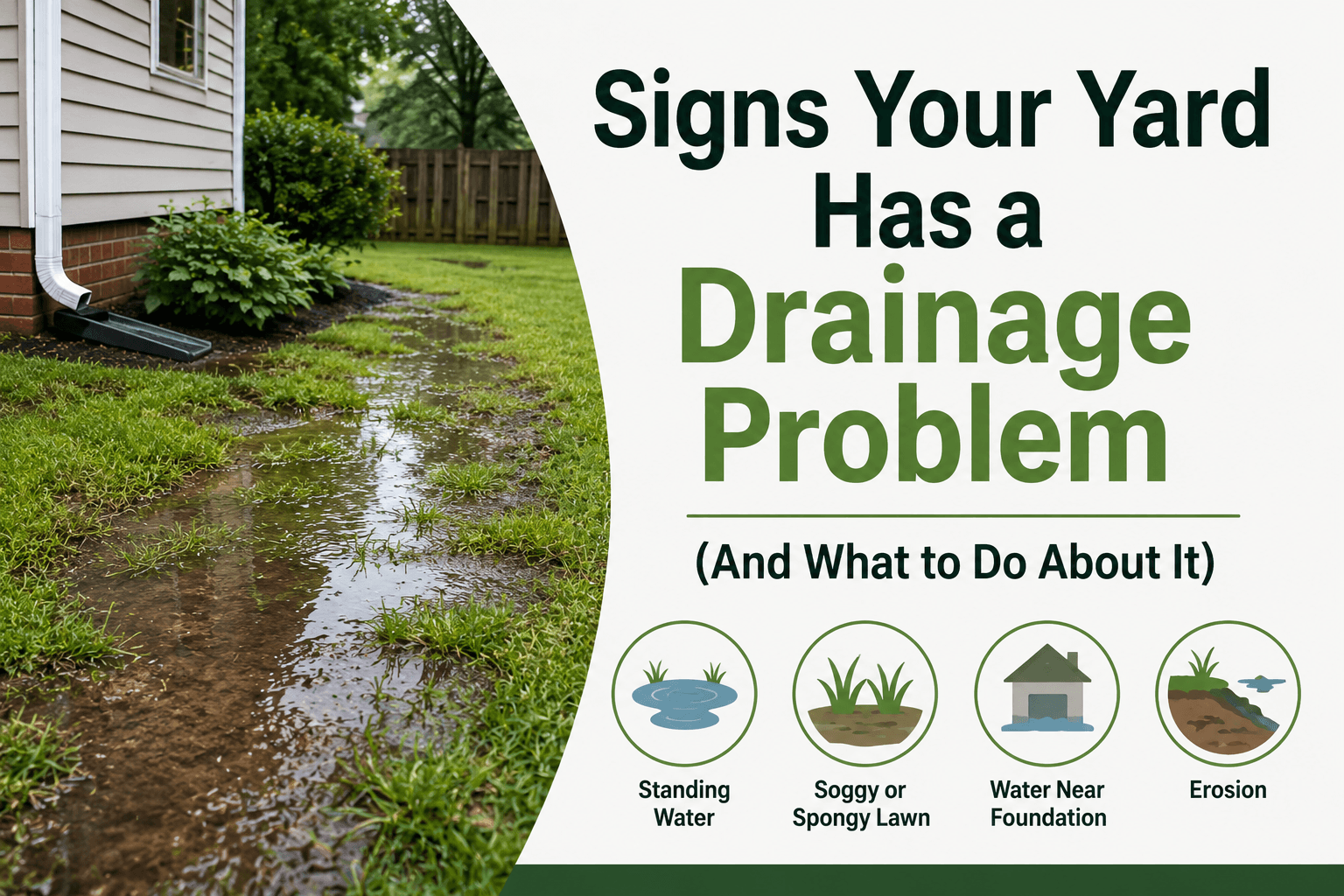
Nashville gets about 54 inches of rain per year, spread across a soil type that was never designed to absorb it quickly. Most of Davidson and Williamson County sits on dense clay, which drains slowly, holds water near the surface, and expands when saturated. That combination makes drainage problems common for Middle Tennessee homeowners, not a sign that something unusual is wrong with your property.
The good news is that most drainage problems are fixable. The question is which signs you’re dealing with, because the right fix depends on where the water is going and what it is affecting. A minor surface pooling issue and water sitting against your foundation look similar after a storm but require very different responses.
This guide covers the nine most common signs of a yard drainage problem in Nashville, what each one typically means, and when you can address it yourself versus when you need a professional assessment.
What Good Drainage Actually Looks Like
Before the signs, it helps to know the baseline. A yard with healthy drainage absorbs moderate rainfall within 24–48 hours. The ground may be soft for a day, but it does not stay wet indefinitely. Water flows away from the house, not toward it.
The industry standard for yard grading is a 2–5% slope away from the foundation. On a 10-foot run from the house, that means the ground drops 2.4–6 inches. Most Nashville lots are graded correctly when they’re built. Over time, settling, tree roots, and erosion shift that grade, and water starts pooling where it shouldn’t.
Nine Signs Your Yard Is Not Draining Properly
1. Water Still Stands 48 Hours After Moderate Rain
This is the clearest and most common sign. A heavy storm can leave temporary puddles anywhere, but water that sits in the same spot for two days or more after a normal rain indicates the soil is not absorbing or redirecting it.
Nashville’s clay soil drains roughly 10 times slower than sandy loam. After a long dry spell, the clay surface crusts over and initially sheds water rather than absorbing it. When spring storms arrive after a dry stretch, even a moderate inch of rain can pool in low spots for days.
What it typically means: poor grading, a low spot in the lawn, or clay soil without adequate drainage infrastructure.
2. Specific Areas Feel Spongy Underfoot, Even Between Rains
If you walk across your yard and certain patches feel soft or give under your feet hours after the last rain, the water table in those areas is too close to the surface. This often happens near downspout discharge points or in spots where the grade directs runoff to collect.
Spongy soil is hard on turf. Grass roots in saturated conditions cannot access the oxygen they need. You will start to see thinning and die-off in those areas, usually by midsummer.
What it typically means: a low spot or drainage blockage directly beneath the surface, often near a pipe outlet or grading irregularity.
3. Mulch or Soil Washes Out of Your Beds After Every Rain
If you find your garden bed mulch deposited on the driveway or sidewalk after storms, water is moving across the surface faster than the soil absorbs it. This is a runoff problem, not an absorption problem. The water has enough velocity to carry material.
On Nashville’s rolling terrain, this often happens on sloped beds with no edging or swale to redirect the flow. Over several seasons, this kind of erosion removes topsoil and exposes root systems.
What it typically means: surface runoff from a slope, an improperly graded bed, or an overwhelmed downspout.
4. Grass Dies or Yellows in the Same Spots Every Spring
Recurring dead patches that appear after the wet season and always in the same location are a signature of drainage failure. Grass roots deprived of oxygen by chronic saturation cannot recover. The yellowing starts as the grass approaches dormancy from the roots up, not the tips.
This sign is easy to misread. Many Nashville homeowners treat these patches with fertilizer or seed in fall, get partial recovery, then watch the same patches die again the following spring. The soil condition is causing the die-off, not the turf.
What it typically means: chronic subsurface saturation, usually from a combination of clay soil and poor surface drainage. The affected areas need a drainage solution, not just new sod.
5. Moss Is Growing Where Grass Won’t
Moss does not cause poor drainage. It thrives because of it. If you have patches of moss in your lawn, particularly in shaded areas that stay consistently moist, the soil in those zones is saturated enough that grass cannot compete.
This sign is more common in North Nashville properties with tree cover and fewer hours of direct sun, where moisture evaporates more slowly. Moss growth is typically a later-stage indicator: by the time it appears, the drainage issue has been present for more than one season.
What it typically means: chronic moisture near the surface, compacted or poorly draining soil, or inadequate surface runoff management.
6. The Soil Near Your Foundation Stays Damp Between Rains
Walk the perimeter of your house a day after a rain. Press a finger into the soil against the foundation. It should feel firm and slightly moist, not wet. If the soil is consistently saturated within a few feet of the foundation wall, water is pooling against the structure rather than draining away.
This is the sign that escalates most quickly from a yard problem to a structural problem. Nashville’s clay soil exerts hydraulic pressure against foundation walls when it holds water. That pressure, called hydrostatic pressure, causes horizontal cracks in block or poured concrete foundations over time.
What it typically means: grade has reversed toward the house (either through settling or landscaping additions), downspouts are discharging too close to the foundation, or subsurface drainage is inadequate.
7. Cracks Are Forming in Your Patio, Driveway, or Retaining Walls
Hardscape cracks from water movement, not just age. When saturated soil expands and contracts with Nashville’s wet-dry cycles, it shifts the base material beneath concrete and pavers. A patio that cracks in the same location repeatedly is telling you the soil beneath it never fully drains.
Retaining wall failure is a more serious version of the same problem. A wall that starts to bow, lean, or separate at the joints is under soil pressure that drainage would relieve.
What it typically means: insufficient drainage beneath or behind the hardscape, or an original installation that did not account for Nashville’s soil movement. B&H’s post on drainage for patio pavers explains how this specific problem works and what a proper fix involves.
8. Your Basement or Crawl Space Has a Musty Smell After Rain
A musty smell after rain does not always mean your basement has flooded. It can mean moisture is moving through foundation walls at a rate low enough to evaporate before pooling but high enough to encourage mold and mildew growth. Efflorescence, the white chalky residue that appears on concrete block walls, is a direct indicator of water moving through the block.
These signs are harder to see than surface water but more expensive to ignore. Foundation moisture problems that start as a musty smell can progress to visible seepage, wall cracking, and structural damage in three to five years on Nashville’s clay-heavy soils.
What it typically means: the yard is directing water toward the foundation rather than away from it. This requires a professional drainage assessment, not a DIY fix.
9. One Area of the Yard Breeds Mosquitoes All Summer
Mosquitoes lay eggs in standing or stagnant water. If one corner of your yard produces mosquitoes all summer despite no obvious pool or container, there is almost always a low spot holding water just below the surface. The standing water may not be visible, but the insects locate it reliably.
This sign is easy to dismiss as a general nuisance. It is also a useful diagnostic: the mosquito activity tells you exactly where the drainage problem is located.
What it typically means: a subsurface drainage problem at a specific point, usually the lowest spot in the yard or a location where a downspout or runoff channel concentrates water.
Why Nashville Yards Are Especially Prone to Drainage Problems
Most of Middle Tennessee sits on Maury series soils or similar fine-grained clay types. These soils have a low permeability rate: water moves through them slowly under the best conditions. During Nashville’s spring storm season, when intense rain events can deliver one to two inches in a few hours, clay soil cannot absorb water at the rate it falls.
The clay behavior is unusual if you have not seen it before. During summer drought, Nashville clay cracks open and appears completely dry. When rain returns, water moves through the cracks quickly at first, then the clay swells shut, and the soil surface becomes nearly impermeable. The result is that a yard that looked fine all summer can flood significantly during the first heavy rain of September.
Nashville also averages nearly 54 inches of precipitation per year, making it wetter than most of the Southeast. That figure is projected to increase, with a larger proportion falling as intense two-day events rather than gentle soaking rains. Properties without adequate drainage infrastructure are absorbing more stress each year.
The rolling terrain across Davidson, Williamson, and Wilson counties means slopes are common. Slopes concentrate runoff. What starts as an inch of rain on a flat surface becomes two or three inches of moving water at the bottom of a grade.
Understanding why soil testing and compaction are the first step before any Nashville landscaping project is a good starting point if you are not sure what your soil type is doing.
What to Do Based on What You’re Seeing
Fixes You Can Handle Yourself
Extend your downspouts. A downspout that discharges within two feet of the foundation is one of the most common causes of foundation moisture problems. A plastic downspout extension costs less than $20 and directs discharge 6–10 feet away from the house. For signs 3, 6, or 8, check your downspouts first before doing anything else.
Fill low spots. Persistent surface pooling in a specific area (sign 1 or 2) is sometimes resolved by raising that area with topsoil mixed with compost. Add enough to create a slight crown over the low spot, seed or sod the area, and monitor it through one or two rain events. This works for minor, localized issues only.
Aerate compacted areas. If your soil drains poorly primarily because it is compacted from foot traffic or heavy equipment (common after construction), core aeration in fall opens the soil structure and improves absorption. This helps with signs 2 and 4 on a minor scale.
Fixes That Require a Professional Drainage Contractor
Regrading. When the slope around your house has reversed or settled toward the foundation, re-establishing a 2–5% outward grade is the correct long-term fix for signs 6 and 8. This involves removing and redistributing soil, which requires equipment and an understanding of where the water will go once it leaves the regraded area. B&H’s grading and excavation service handles this for both residential and commercial properties.
French drain installation. A French drain is a perforated pipe buried in a gravel-filled trench that intercepts subsurface water and routes it to a safe discharge point. It is the right fix for signs 1, 2, 4, 5, 6, and 9, particularly when the problem covers a larger area or sits close to the foundation. B&H’s French drain installation guide explains how these systems work and what installation involves on a Nashville property.
Catch basins and channel drains. When concentrated surface water flows across a patio or driveway and has no outlet, a catch basin or trench drain intercepts it at the surface and routes it underground. This is the correct fix for sign 3 (mulch and soil washing across hardscape) and sign 7 (hardscape cracking from movement beneath).
Drainage system design. Complex sites with multiple problem types, significant slopes, or issues near the foundation require a full drainage assessment before any single solution is installed. Installing a French drain in the wrong location can redirect water toward another problem area. A designed system routes water through a mapped path from source to outlet. B&H’s full Nashville drainage services cover system design and installation across all of these problem types. For a broader overview of which system fits which problem, B&H’s guide to yard drainage systems walks through the options.
Dry creek beds and swales. On Nashville properties with significant slope, a dry creek bed or planted swale can redirect surface runoff to a safe discharge area while adding visual interest to the yard. This is the right approach for sign 3 on sloped properties where regrading alone is insufficient.
When to Stop Waiting and Call Someone
Some drainage problems progress slowly enough that delaying a fix has limited consequences. Others worsen with each storm. Get a professional assessment without delay if:
- Water consistently stands within 5 feet of the foundation after any rain
- Your basement or crawl space shows moisture, efflorescence, or mold
- Horizontal cracks are appearing in foundation or retaining walls
- Hardscape is cracking in the same locations repeatedly despite repairs
- An area of the yard has been consistently wet for more than one full season
- Trees or large shrubs have died without explanation in an area that stays wet
These are not signs to monitor. Each of them indicates that water is already affecting a structure or a plant system, and the rate of damage typically accelerates.
B&H offers free drainage assessments for Nashville-area homeowners, covering all of its service territory across Davidson County and the surrounding suburbs.
Nashville Yard Drainage Frequently Asked Questions
How long should water sit in a yard after rain?
Water should drain from a properly graded yard within 24–48 hours of moderate rainfall. Water that remains after 48 hours in the same location consistently points to a drainage problem worth addressing.
Can I fix a yard drainage problem myself?
Minor issues, filling a low spot, extending a downspout, aerating compacted soil, are reasonable DIY projects. Anything involving subsurface water, foundation moisture, slope modification, or a drainage system that spans more than a small area needs a contractor with drainage design experience. An improperly placed French drain can redirect water toward a problem rather than away from one.
Does Nashville’s clay soil make drainage worse?
Yes, significantly. Clay soil has very low permeability. Nashville’s specific clay types can absorb roughly one-tenth the water per hour that sandy soils absorb. When intense spring storms deliver rainfall faster than the clay can drain, water has nowhere to go except across the surface or against whatever structure is downhill. This is why Nashville homeowners deal with drainage problems at higher rates than homeowners in sandier soil regions.
Do I need a permit to install a French drain in Nashville?
Permit requirements depend on the scope and location of the work. Projects that involve altering drainage near a waterway, drainage easement, or Metro Nashville right-of-way typically require a land disturbance permit. A licensed contractor handles permit research and filing as part of the project.
What is the most common cause of yard drainage problems in Nashville?
Reversed or insufficient grading is the most common cause. Most Nashville homes are graded correctly when built, but over 10–20 years the ground settles, landscaping is added, and the slope gradually shifts back toward the foundation. This is followed closely by clay soil compaction from foot traffic and construction activity, and by downspouts that discharge too close to the house.
How much does drainage repair cost in Nashville?
The 2026 Nashville landscaping cost guide covers drainage pricing in detail. French drain installation in Nashville typically runs $8,000–$15,000 depending on property size and system complexity. Downspout extensions cost under $100 as a DIY project. Regrading runs $0.40–$2.00 per square foot depending on scope.